 Worldwide Presence

Top 3 Ways Simulation Training Improves Airway Management Skills
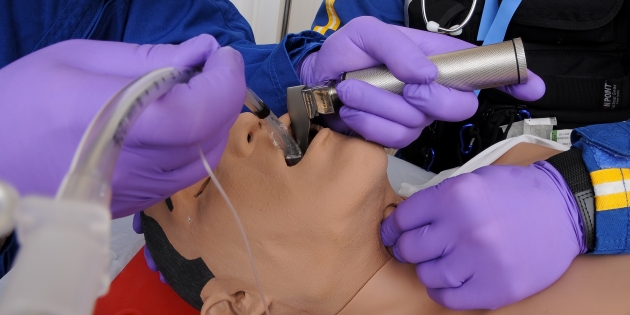
Airway management is an essential skill for anesthesiologists, emergency medical technicians, and other health professionals involved in critical patient care. However, there are a number of physiological complications and unforeseen situations (an unresponsive patient, a morbidly obese patient, a difficult or obstructed airway, vomiting risks, distorted/abnormal anatomy, etc.) that could make successfully performing this crucial procedure problematic for an inadequately trained health worker.
Because immediate and decisive life-saving action must be taken at the very first signs of compromised airway function, intense training for procedural proficiency in airway management is imperative.
Simulation Training as Adjunct Airway Management Instruction
Several research studies support the considerable benefit of using high fidelity patient simulators for airway management training.
In one particular instance, learners who trained on a Medical Education Technologies Inc. (METI) Emergency Care Simulator (ECS®) for airway management as an adjunct to structured clinical experience on human subjects, and other training modalities, self-reported improvement in three essential areas:
- Skills Competency
- Technical Knowledge
- Confidence Levels, especially when performingdelicate, life-saving procedures such as intubation and chest tube insertion
When simulation is added to traditional airway management instruction, learners benefit by receiving intensive, low-risk training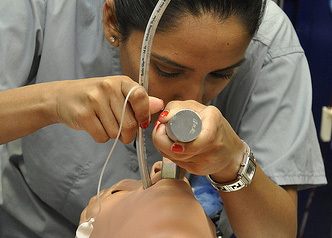 in critical care protocols, including
- difficult and advanced airway management
- pre-hospital airway management
- airway trauma and surgical airway management (cricothyrotomy, laryngoscopy, etc.)
- proper bag-valve mask ventilation
- intubation (from basic, to can't ventilate-can't intubate with surgical airway placement)
- airway difficulty assessment, in order to determine the most appropriate approach
Opportunities for Simulation Training in Airway Management
CAE Healthcare simulators offer a wealth of opportunity for airway management training in high-risk situations -- with no danger to living patients. Unlike real patients, a high-fidelity simulator can be programmed to reproduce different airway complications, patient profiles and multi-faceted pathologies. Learners are able to practice skills under increasingly difficult conditions until they develop clinical proficiency in specific techniques.
With CAE Healthcare patient simulators, learners also benefit from training on state-of-the-art technology with simulators that generate data streams for patient monitoring systems in anesthesia, intensive care, and emergency medicine. From routine intubation to difficult airway management, simulation-based instruction helps learners achieve mastery in clinical procedure, rapid decision-making and effective teamwork.
Discover more about CAE Healthcare's Simulated Clinical Experiences (SCEs) in airway management, diagnostic evaluation, advanced life support (ALS) and more, including tools for performance assessment, crew resource management (CRM) and debriefing.
Follow CAE Healthcare on our Social Pages: Facebook and LinkedIn
Sources:
- Kennedy CC et al. Advanced airway management simulation training in medical education: A systematic review and meta¬analysis. Critical Care Medicine, 2014
- Kory PD, Eisen LA, Adachi M, Ribaudo VA, Rosenthal ME, Mayo PH. Initial airway management skills of senior residents: simulation training compared with traditional training. Chest. 2007
- Shukla A, Kline D, et al. A Simulation Course on Lifesaving Techniques for Third Year Medical Students. Simulation in Healthcare. 2007