 Présence mondiale

Le camp d’entraînement que les résidents en médecine adorent
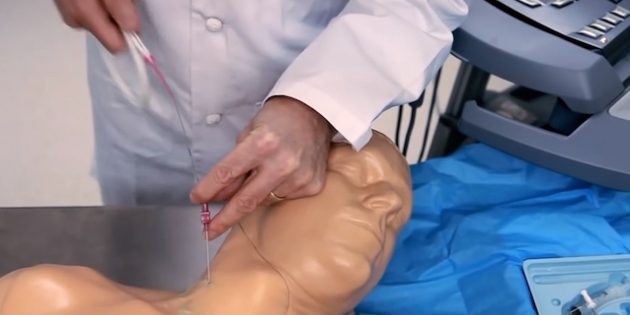
ER residents at Hartford Hospital practice the next standard of care before they touch real patients
You won’t find dumbbells or medicine balls at this boot camp, but the training is intense, focused, and gets results. The University of Connecticut Emergency Medicine Residency Intern Boot Camp at Hartford Hospital spans two days and covers renal, cardiac, thoracic, trans-abdominal and musculoskeletal scanning as well as ultrasound-guided procedures. Over the past three years, Emergency Ultrasound Director Meghan Kelly Herbst, MD, has helped to teach more than sixty new residents how to place central lines and peripheral lines with ultrasound guidance before they ever have to stick a real patient.
Placement of both central and peripheral lines are common procedures in emergency rooms when patients need IV medications to be administered directly into the bloodstream. Often, a nurse will make the first attempt to place a peripheral line, but if unsuccessful, he or she will call upon a physician. With ultrasound, a physician can see the vein and surrounding structures as he or she guides the needle before placing the catheter.
At the Hartford Hospital Boot Camp, the residents practice non-invasive ultrasound, like the aortic exam, on other residents. For invasive procedures that require sticking a patient, they practice with CAE’s Blue Phantom ultrasound models and ultrasound machines. Many say that the time spent placing central and peripheral lines is the most useful part of the boot camp.
“We’ve gotten excellent feedback,” says Dr. Herbst. “As a medical student, I was taught to do central lines blindly. As a resident here, I was taught by Tom Nowicki (Director of Cognitive Simulation) and did all the central line training with ultrasound guidance.”
She opens the ultrasound boot camp by asking how many of the residents have touched an ultrasound probe. “Of 18, usually five or fewer have done any sort of formal ultrasound education. We start with an intro on the physics of ultrasound and how to hold the probe.”
After two days, residents gain enough confidence to use ultrasound for both central line and peripheral procedures. “Some first years will get the needle in on the first try because they had the training in the simulation center,” she says.
“I think peripheral line placement is much more difficult than central because it’s a smaller target even though the patients aren’t as sick. The challenge is the hand-eye coordination in getting the needle where you want it, and it can be very uncomfortable for the patient. And the procedure can be even more difficult in patients who are obese, or IV drug users or sickle cell patients,” says Dr. Herbst.
For central line placement, the evidence is solid: ultrasound guidance should be the standard of care. While Hartford Medical has seen a decrease in bloodstream infections since introducing its simulation training for central venous access, it’s commonly accepted that the use of ultrasound can also reduce the incidence of other complications like pneumothorax, arterial injury, hematoma or vessel wall damage.
“It’s not worth the risk,” says Dr. Herbst. “Today, I refuse to do any procedure without ultrasound. I harp on the fact that ultrasound is going to be the standard of care for everything.”
The Hartford Medical Center for Education, Simulation and Innovation uses CAE Blue Phantom ultrasound models to teach residents and practitioners to perform ultrasound. Learn more about CAE Blue Phantom models for Central Line Placement, Peripheral Access, the Focused Assessment with Sonography for Trauma (FAST) exam and more.
Watch a video about the Hartford Medical CESI.
Stay informed! Subscribe to the CAE Healthcare blog!