 Worldwide Presence

Three Things You Didn’t Know About Childbirth Simulation with Lucina
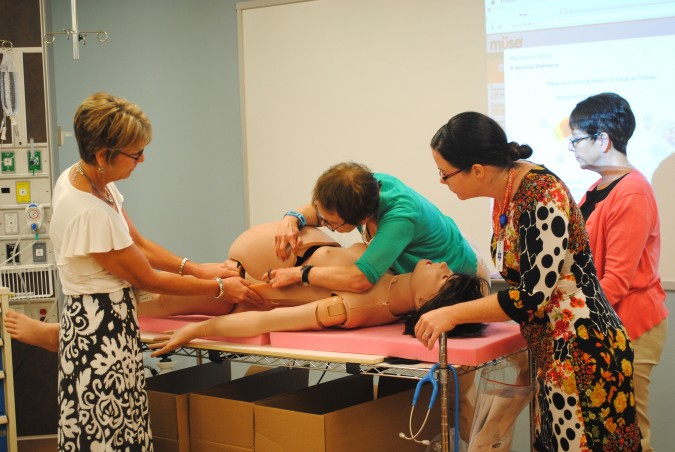
Three nurse educators braved the Florida heat in August to attend a hands-on course on the new Fidelis Lucina childbirth simulator at the CAE Healthcare Sarasota facility.
Sheila Kane, RN, MSCNE and Sharon Hamel, RN, BSN of Northern Essex Community College, which opened a new simulation center this year, and Heather Heilman, RNC of Kishwaukee College have years of clinical experience in the hospital setting as well as the nursing classroom. In the “train the trainers” course hosted by the CAE Healthcare Academy, they learned how to operate and maintain Lucina as well as how to teach obstetrical scenarios such as shoulder dystocia, breech delivery and postpartum hemorrhage.
Here are three things they learned about childbirth simulation with Lucina:
She’s versatile, and able to do much more than birth babies.
“We pictured her originally as an OB inpatient,” said Sheila Kane. “We’re most likely going to want to make her more portable and maybe put her on a stretcher.” Kane and Sharon Hamel plan to take Lucina into the classroom where she can help learners practice fundamentals such as Leopold’s maneuver and cervical dilation as well.
“For the Leopold’s maneuver when you are determining which way the baby is facing –students have a hard time understanding the terminology. With Lucina, they can determine the position and then open her belly and check. Or you can leave the belly open and have the student put the fetus in that position. It would be so much more vivid than learning on a PowerPoint,” says Hamel.
Built on the new Fidelis simulator platform, Lucina offers metrics that measure the effectiveness of CPR and an airway designed for the practice of airway management. She also supports mechanical ventilation, and can be operated as a non-pregnant female with the addition of her Female Patient Module. “She has attributes that are complementary to respiratory and other departments, paramedics, medical assisting and basic level radiology,” said Hamel. “We could incorporate her into the medical-surgical nursing clinical course. She would augment their learning.”
You can speed up her delivery time for in situ simulations.
Heather Heilman works in a Neonatal Intensive Care unit in a hospital that plans surprise, 10-15 minute in situ simulations. Once they called staff to the hospital parking lot at 2 a.m. to perform a premature delivery in the back of an ambulance.
“Lucina would be really useful in a hospital in an in situ simulation on the floor. The fact you can speed up her delivery is really helpful,” says Heilman. (Lucina’s delivery time can be as short as one minute or longer than two hours.)
“The hospital once had a patient with post-partum hemorrhage who coded. They spent a year repeating simulations of that scenario,” Heilman says. “Because of Lucina’s CPR functionality and because you can make her bleed so much, she would be a better simulator for that scenario.”
She may be the closest thing to a delivery nursing students see before they graduate.
“We have a couple of students every semester who don’t see a real delivery during their clinicals,” said Heilman. You try your best, but maybe nobody delivered while they were on the floor.” Those nurses might start their first day on the job without any labor and delivery experience. With Lucina, they will be able to watch and practice a realistic delivery before they have to participate in a live one.
“That’s the beauty of simulation,” says Kane, “You don’t have to wait for a particular patient population to present before you can practice.”
Learn more about the CAE Fidelis™ Lucina childbirth simulator.
CAE Healthcare delivers medical simulation solutions to improve patient safety and outcomes. The high-fidelity CAE Fidelis Lucina childbirth simulator is designed to allow medical teams to practice both obstetrical emergencies and normal labor and delivery.
Stay informed. Subscribe to the CAE Healthcare blog!