 Worldwide Presence

Six Keys to Sustaining a Successful Simulation Training Program for Maternity Care
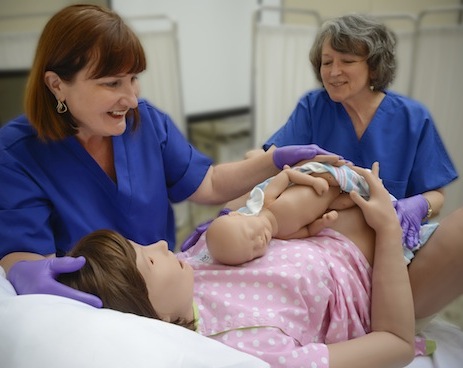
Simulation-based training for obstetric emergencies, such as post-partum hemorrhage or cardiac arrest during delivery, can improve team communication and interaction as well as the knowledge and confidence of individual learners. Simulation training can facilitate a well-coordinated rapid response during critical moments for mother and baby.
In 2011, physician educators from Portugal, the United States and the United Kingdom reviewed simulation-based maternity training programs in their countries to find common threads among those that remained successful over the years. Their review, “Sustaining simulation training programmes – experience from maternity care” was published in BJOG An International Journal of Obstetrics and Gynaecology.
Prof. Diogo Ayres-de-Campos, Dr. Shad Deering and Dr. Dimitrios Siassakos discovered six key elements among sustainable maternal simulation programs.
Clear institutional level commitment to the course – often motivated by financial incentives (such as lower insurance premiums), institutional commitment helps overcome barriers like staff resistance.
Strong leadership in course organization – from carefully planned scenarios that relate to clinical practice to the effective use of simulators, the leadership supports the vision and addresses everyday operational challenges.
Curriculum relevant to clinical practice – the curriculum needs to be well-organized, relevant to practice and to follow evidence-based, national or international guidelines.
A non-threatening learning environment – a constructive, non-judgmental process, especially during debrief, is essential to encourage full participation and the growth of individuals and teams.
Multi-professional training – involving physicians, nurses, and anesthesiologists is the only way to allow teams to address communication, patient management and their respective roles.
Simulators appropriate to learning objectives – While a high-fidelity manikin is ideal for practice of cardio-pulmonary resuscitation, a patient actor may also be suited to practice patient-physician communication.
To learn more, read the full maternity care simulation study.
Practice obstetrical emergencies like cardiac arrest with the CAE Fidelis™ Lucina childbirth simulator.
Like what you just read? Subscribe to the CAE Healthcare blog to receive more articles like this.
Citation: Ayres-de-Campos, D., Deering, S. and Siassakos, D. Sustaining simulation training programmes – experience from maternity care. BJOG 2011;118 (Suppl. 3) 22–26.