Every day is an opportunity to reflect on our liberties, and to honor those who risk their lives to continually protect those freedoms all over the world.
It's also a time to think seriously about crisis care medical teams (combat medics, included), and the degree of preparation required to become the life-saving heroes they so often are. Simulation-based training in battlefield triage and traumatic care has shown itself to be a significant contributor to improved medical outcomes.
Realistic Combat Medical Training with Simulators
High fidelity medical simulators can represent real battlefield situations. Because immediate and effective pre-hospital care is essential to stabilize an injured patient (and to successfully transport him/her to a well-equipped medical facility), training for military medical teams now include highly immersive, simulated environments that suspend disbelief and deliver the highest quality of dynamic learning.
For example, a realistic medical training exercise might involve
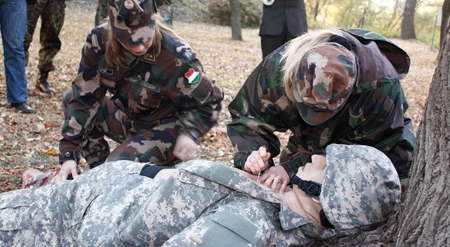
One entity that has been utilizing simulation-based medical training in this way is the University of Toledo's Interprofessional Immersive Simulation Center, in cooperation with CAE, Cubic Global Defense, and the Air Force.
"The medics are finding the realism of this so high, you can feel them react as if these are their victims they're going to rescue," said Benjamin Stobbe administrative director for The University of Toledo's Interprofessional Immersive Simulation Center.*
Caesar: Durable Simulator for Trauma Patient Care Training
CAE Healthcare's Caesar Trauma Patient Simulator was developed from the US Army Medical Department Center and School's COMETS Autonomous Casualty Simulator program with validated physiology that can mimic a real-life, battlefield casualty.
As a tetherless, durable and rugged high-fidelity trauma patient simulator, Caesar can be used under extreme conditions. The simulator is also configured to present over twenty different, pre-programmed critical injury scenarios -- including
A simulator such as Caesar offers clinical accuracy for basic to advanced point-of-injury training, thereby providing all levels of crisis medical teams (from trauma nurses to EMS and medics) with realistic practice and training to improve survivability rates, even under the most extreme conditions.
According to an editorial by David M. Gaba, MD (2002), using simulation to educate and train healthcare professionals holds the greatest potential to influence patient safety. What might be the benefits for combat troops? Please share your comments below.
Learn more about the Caesar Trauma Patient Simulator
To request a demo, or to receive more information contact CAE Healthcare
Share This Page On Your Favorite Social Networks!




Subscribe and never miss a CAE Healthcare Medical Simulation Blog update!
*AirForceTimes online, June 14, 2015 "Military Rescuers Train with Next-Gen Medical Simulator", by Phillip Swarts
 Worldwide Presence