 Worldwide Presence

TeamSTEPPS Glossary 1: Assertion, Call-Outs, & Check-Backs

The following is the first installment in a short series on understanding several key terms, tools and practices related to TeamSTEPPS concepts for enhanced team-based communications and patient care.
Team Strategies and Tools to Enhance Performance and Patient Safety (TeamSTEPPS) is an evidence-based, systematic approach to improving communication, patient safety, and teamwork skills among health care professionals.
Developed by the Department of Defense (DoD) and the Agency for Healthcare Research and Quality (AHRQ), in response to the 1999 Institute of Medicine (IOM) report, To Err is Human, TeamSTEPPS is based on 25 years of research related to teamwork, team training, and culture change.
Simulation-based learning and TeamSTEPPS training are oftentimes utilized in concert to reinforce team-building communication skills within a medical environment, to minimize patient risk and strengthen teamwork principles. The establishment of a national infrastructure for wide-scale dissemination of TeamSTEPPS-based training protocols is currently underway.
CAE Healthcare provides the following glossary of terms as a basic introduction to the tools and strategies on which TeamSTEPPS is based. To learn more, please review the hyperlinks located at the conclusion of this list.
TeamSTEPPS Glossary (Part 1)
-
Advocacy and Assertion – Techniques for intervening when your viewpoint does not match that of the decision-maker.
-
Adaptability – The ability to adjust strategies and altering a course of action in response to changing conditions (internal or external).
-
Brief – Discussion prior to starting that assigns essential roles, establishes expectation, anticipated outcomes, and likely contingencies.
-
Call Out – A tactic used to communicate critical information during an emergent event. Assists the team to anticipate and prepare for vital next steps. Information is directed to a specific individual who will be primarily responsible for carrying out the task.
-
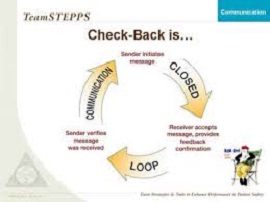
Check Back – A closed loop communication strategy used to verify and validate information that has been exchanged. Both the sender and receiver are involved and there is a cyclical nature (or, 'double-check') that assures information has been sent, received and properly understood.
- Closed-Loop Communication/Information Exchange – The initiation of a message by a sender, the receipt and verbal acknowledgement of the message by the receiver, and the verification/confirmation of the message by the initial sender.
A closed loop/check-back communication exchange in a clinical environment, using a person-specific callout ("Nurse Cullen, clear the airway." "Clear the airway now, doctor"? "Yes, Nurse Cullen. Now" "Commencing with clearing the airway" ) helps to ensure that
a) the communication will be clearly heard by the intended recipient, and
b) the call out will more likely be carried out, since the communication has a clearly defined recipient
Studies have shown that orders called out ‘in the air’ were found to lead to task overload for the members of resuscitation teams, thus having a negative influence on team performance, and quality of carex .
Each year an annual collaborative of TeamSTEPPS users meets for educational networking and community building. For details, visit AHRQ.Gov.
Subscribe to the CAE Healthcare Blog for future updates to this TeamSTEPPS series, as well other relevant articles.
Discover Simulation-Based Learning Opportunities through the CAE Healthcare Academy
Share This Helpful Post on Social Channels!




xAndersen PO, Jensen MK, Lippert A, et al. Identifying non-technical skills and barriers for improvement of teamwork in cardiac arrest teams. Resuscitation 2010;81:695–702