 Worldwide Presence

5 Ways Fidelis Lucina Trains on Life-Saving QBL and PPH Recognition
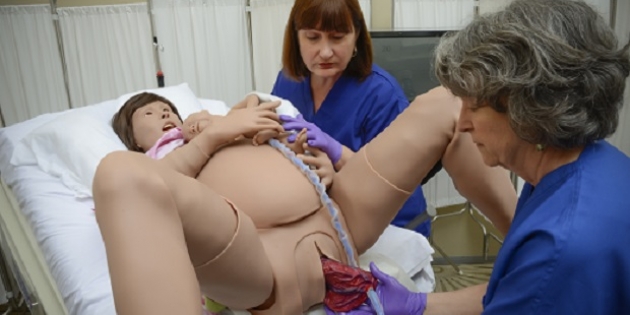
The CAE Fidelis Lucina™ Maternal Fetal Childbirth Simulator is unique in many ways, not least of which is the ability to train learners on quantification of blood loss (QBL) for recognizing and treating postpartum hemorrhage (PPH).
While it’s perfectly normal to experience some blood loss during childbirth as the placenta separates from the uterus, and to lose more blood from open blood vessels immediately following delivery, up to six percent of women have excessive blood loss (postpartum hemorrhage, or PPH) when the uterus fails to contract after birth.
When excessive blood loss goes unrecognized, and intervening measures are not taken expediently, the result can be catastrophic. According to the World Health Organization (WHO) obstetric hemorrhage is the leading cause of maternal morbidity worldwide.
Quantification of Blood Loss (QBL) is an effective method for evaluating excessive bleeding. QBL may reduce failure to recognize the volume of blood lost during a maternal event. Skills training in QBL may also benefit a clinician's responsiveness to excessive blood loss.
Guest blogger, CAE Healthcare Adjunct Faculty Karla Olson, (RN, MSN, RNC-OB, C-EFM, CBC, CLNC) offers the following insights into this major crisis in women’s healthcare with a focus on simulation-based training with CAE Fidelis Lucina for quantifying blood loss, detecting a life-threatening hemorrhage and improving clinical outcomes.
Maternal mortality from blood loss occurs when postpartum hemorrhage (PPH) is not recognized early, and effective interventions are not initiated in time. Simulation practice with the Fidelis Lucina Childbirth Simulator provides several training opportunities to help prepare delivery teams in understanding the dynamics of PPH so that medical teams may respond appropriately.
Uterine Massage: The ability to palpate and perform an effective uterine massage is the first step in the treatment of PPH. The Lucina simulator has internal sensors that are engineered to recognize and respond to effective uterine massage. If a uterine massage is not effective, the uterus will not contract (and bleeding will continue).
Uterine Atony: Initial assessment of uterine atony to determine whether the uterus is firmly contracted can be modeled with this simulator. Lucina can be programmed to present a firm uterus. Fifteen minutes later, she could present with a boggy uterus and bleed at various rates.
Placental Examination: Additionally, Lucina has both an intact and fragmented placenta. While examination of the placenta for retained fragments is a routine procedure for all deliveries, it is essential to recognize in the case of postpartum hemorrhage.
Uterine Tamponade: Lucina’s uterus is also capable of uterine tamponade by the placement of an intrauterine balloon device. Placement of the tamponade balloon is a high risk, low frequency procedure used in the case of intractable uterine atony. Simulation training with Lucina allows the learner to become proficient in this potentially lifesaving procedure.
QBL with Fidelis Lucina: The physiology that is programmed into Lucina allows the simulation participant to recognize and quantify blood loss. They can assess how rapidly they must respond with both uterine massage and the use of uterotonic agents. Lucina’s vaginal bleeding reservoir holds two liters of fluid and blood loss is modeled on true physiology. Appropriate changes occur in Lucina’s heart rate, blood pressure, and respiratory parameters for a more realistic training experience.
During a simulated clinical experience (SCE), learners come to understand that prompt and appropriate lifesaving interventions, blood transfusion, and the treatment of shock are actions that must be taken in response to a massive hemorrhage. The postpartum uterus features and programmed physiology of the Fidelis Lucina Childbirth Simulator can successfully train on life-saving QBL and PPH recognition in a safe and controlled environment, instilling clinical thinking and reaction skills that may be effectively transferred to real life situations.
AWHONN (the Association of Women’s Health, Obstetric, and Neonatal Nurses) has released a series of clinical practice videos on maternal and neonatal care.
> > View the AWHONN "Quantification of Blood Loss" video here
 Karla Olson, RN, MSN, RNC-OB, C-EFM, CBC, CLNC is an active Registered Nurse, Certified Perinatal Education Instructor, ACLS provider and AWHONN Instructor for Electronic Fetal Monitoring with decades of experience in inpatient obstetrics, labor & delivery, NICU, pediatrics, and hospital education. Ms. Olson has presented on obstetric emergencies, perinatal nursing, and critical thinking for nurses, and is the co-author of medical-related publications for the Sarasota Memorial Health Care System, based in Sarasota Florida.
Receive automatic updates on new blog posts:
Subscribe to the CAE Healthcare Blog
Connect with us on Social Media:
Share this page
Sources:
Cochrane Database Syst Rev. 2013 Jul 1;7:CD006431. doi: 10.1002/14651858.CD006431.pub3.
Hofmeyr GJ, Abdel-Aleem H, Abdel-Aleem MA. Uterine massage for preventing postpartum haemorrhage.
World Health Organization. Maternal Mortality in 2000: Estimates by WHO, UNICEF, UNFPA. Geneva: World Health Organization; 2004.