 Worldwide Presence

Educator:Innovator - Dobbins Air Reserve Base

Educator Innovator: Dobbins Air Reserve Base in Marietta, Georgia, USA
Q&A with Maj. Chad Corliss, Director of Operations
CAE Healthcare, along with CAE’s Defence and Security business unit, will provide a full training solution to Dobbins Air Reserve Base for Aeromedical Evacuation. This state-of-the-art training system will include a C-130 fuselage trainer that will be fully equipped with high-fidelity patient simulators, including the iStan, to provide military medics with a realistic training environment. Maj. Corliss shares how this project came to fruition and why this project will further advance aeromedical training for the U.S. Air Force.
Tell us about the new Aeromedical Evacuation training system at Dobbins Air Reserve Base and what makes this simulation training program unique?
This system will include the Aeromedical Evacuation Training Device (AETD) designed by CAE USA, CAE Healthcare’s high-fidelity patient simulators and a curriculum tailored to the en route patient care system. This will be the first comprehensive system designed to meet both the clinical and aircrew training requirements for U.S. Air Force Reserve aeromedical crews. This simulator package will be on par with the flight simulation training in use by USAF aviators allowing full mission training in a simulated environment of care.
How many learners do you expect to utilize the AE training system a year, and why is this type of system crucial for their education and training?
The Air Force Reserve Command (AFRC) has 1800 aeromedical crew members that this training is open to, each requiring multiple aircrew and clinical training requirements to be met several times a year. Historically that training is limited to clinical in a hospital environment, when available, and in-flight training for Aeromedical Readiness Missions (ARMs). Given the Air Force’s expected reduction in flying hours due to the fiscal environment, a new training venue is essential.
The pilots in the AF already utilize simulator training to maintain requirements. This is crucial to ensure that AFRC aeromedical crews are ready and proficient when needed to airlift wounded warriors around the world or respond to the evacuation needs during a Defense Support to Civil Authorities (DSCA) event such as a hurricane evacuation or the Haitian earthquake.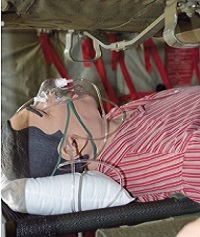
What types of scenarios/training situations will this allow you to carry out?
The curriculum and training devices are being developed to support the entire spectrum of aeromedical evacuation from movement of injured combat troops to the movement of civilian population during a DSCA event. The system is being designed to not only provide for the clinical care in the air, but to ensure crews are trained for aircraft emergencies as well to provide the safest transport possible.
How does a realistic training environment like this help to further immerse the learner in their training and suspend disbelief?
We have long used our ARMs to practice patient movement using additional crew members as standardized patients. This limitation is that we can only simulate certain injuries and the treatments cannot be fully executed. Also, we have no way to replicate a mission for validation or for training repetition. With this system we will be able to take a crew and place them in a mission scenario with a full patient load to experience the stresses from the noise, the decreased lighting and the temperature variations that can occur during flight.
Working on a high-fidelity patient simulator in a lab is effective for clinical understanding but not until I move crews into the aircraft environment where their resources are limited to what is available in the AE in flight kit and the knowledge possessed by the crew can we truly immerse the learners.
The AE system is a long-time user and proponent of Crew Resource Management and has multiple CRM training requirements. This system will allow us to focus with greater clarity and realism on the effect of proper CRM. Using this training system will allow for the requested training repetitions and also allow us to spend time in effective mission and training debriefings with full scenario/ mission information and video recordings available.
What are some the factors that have contributed to the success of establishing the project?
 First was the leadership team at both Dobbins AFB and the HQ AFRC recognizing that this type of training was not only needed; but possible. Then CAE listened to the requirements and presented the solutions to meet the requirements.
CAE, with its long history of developing world-class flight simulators, has been training air force and commercial pilots and flight crews for years. CAE Healthcare combined available training solutions with experience and developed realistic, evidence-based scenarios to provide an opportunity that is unmatched.
What are some challenges you or your program has faced to meet its goals?
Development of all the requirements; we have been training AE crews for a long time but sitting down and getting people to realize that just because we have always trained this way doesn’t mean there isn’t another way. The medical world is still relatively new to full simulation training; while our flight crews have been doing it for years and are fully invested. We also worked through many funding issues. Securing funding in a restricted fiscal environment presented challenges. However, in the end the benefits were able to stand the test and scrutiny at all levels once it became apparent that these types of solutions are now not only possible but required.
How do you see the success of this project leading to similar initiatives across the Air Force that combine aircraft and simulators?
We have always trained with both patients and aircraft. The difference is now we can control the environment, the timing, and the duration of training. We will not be limited by other training requirements nor have considerations of weather to impact the training. And we can run a scenario, debrief the training and if needed go run that scenario again.
This will provide a training capability and capacity that is un-matched. Once the effectiveness of training is seen, we believe that simulation training will not be perceived as a possible adjunct but rather a fundamental element of training.
What advice would you give to other training programs that are looking to create a realistic training environment for simulation?
Focus on your requirements and not just the requirements you see today. Look at your historical requirements and then look forward; imagine what you could do. We are often are own limiters. A realistic training environment is critical to ensure effective training and immerse a learner into a scenario.
Look to see what others are doing and not just in your field. Visit other disciplines and see how do they train and what can I learn from their training. Build partnerships and be ready when an opportunity presents itself.
This is the latest installment of our Educator Innovator blog series in which we put the spotlight on the exciting initiatives being developed by you, our CAE Healthcare family. If you’re interested in featuring your program in Educator Innovator, please send an e-mail to [email protected].