Worldwide Presence



Reliable childbirth simulation with no downtime
CAE’s maternal-fetal simulator is intended for training doctors, midwives, nurses, and allied health professionals in the management of normal childbirth and complications arising from childbirth and pregnancy. CAE’s maternal birthing simulator offers a new level of realism in training and practice of interventions for delivery complications, interventions for maternal emergencies, and realistic patient transport.
Download the flyer
The only birthing simulator with validated models of maternal and fetal physiology
The CAE Fidelis™ childbirth simulator was developed in partnership with leading maternal-fetal educators and biomedical engineers. Its integrated mother-baby physiology and childbirth training scenarios are based on validated physiological models. Our modeling allows learners to monitor how both mother and fetus respond to clinical procedures, maneuvers and the administration of drugs without instructor intervention.

Developed in collaboration with Instituto de Engenharia Biomédica (INEB) at the University of Porto in Portugal


A revolutionary birthing process and a more realistic look and feel
The Fidelis birthing simulator delivers automatically by means of a birthing process that was engineered to be stable, reliable, realistic and quieter than the competition. You have to see it and hear it to believe it.
The Fidelis childbirth simulator’s abdomen simulates the appropriate firmness during uterine contractions. She has multiple, interchangeable cervices with realistic dilation, effacement and consistency. Her body is correctly proportioned, and the fetus falls within the World Health Organization (WHO) growth chart standards for a full-term newborn. The fetus cries after delivery, allowing learners to instantly assess its health.
Better articulation and metrics for practice of labor and delivery maneuvers
The Fidelis birthing simulator offers full articulation in its waist, hips and thighs, with visible pelvic tilt for practice of obstetric maneuvers. With automatic detection and response, learners can monitor the success of maneuvers including left lateral tilt, the McRoberts maneuver, suprapubic pressure, Rubin II and uterine massage. For example, only CAE Healthcare’s maternal-fetal simulator detects the Zavanelli maneuver to resolve shoulder dystocia and provides a realistic resistance to the upward movement of the fetus.


Practice rare obstetrical emergencies with inter-professional teams
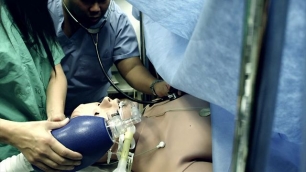
Around 1 in 30,000 pregnancies are complicated by maternal cardiopulmonary arrest. The Fidelis childbirth simulator measures the quality and depth of chest compressions, ventilation rate and volume, cardiac output, and more. Its post-partum hemorrhage reservoir holds blood for practice of a wider range of hemorrhaging scenarios. This birthing simulator can also display signs of maternal seizure, including tremor, rapid blinking, jaw movement and stertorous breathing. The birthing simulator’s built-in metrics allow instructors to assess team performance objectively.
Ten Simulated Clinical Experiences (SCE) included
The CAE Fidelis Maternal Fetal Simulator will be operated by an updated, user-friendly Müse interface that includes ten practice scenarios complete with patient background, evidence-based documentation, learning objectives, facilitator’s notes, supply lists, debriefing questions and more.
CAE Fidelis Maternal Fetal Simulator Simulated Clinical Experiences
- A normal delivery
- An instrumental vaginal delivery
- Cesarean section
- Breech delivery
- Fetal central nervous system depression by narcotics given to the mother
- Shoulder dystocia
- Major post-partum hemorrhage due to uterine atony
- Maternal cardio-respiratory arrest
- Eclampsia
- Umbilical cord prolapse


APGAR score reflects health of baby after childbirth simulation
The Fidelis Maternal Fetal simulator allows practice of a realistic vacuum extraction procedure. After delivery, our Müse interface will display one- and five-minute APGAR scores, as well as umbilical artery and vein blood gas values that reflect how well the learners managed the delivery. The birthing simulator then allows learners to practice using the appropriate amount of force when delivering the intact or fragmented placenta.